Showing posts with label Pakistan. Show all posts

Monday, 23 November 2009

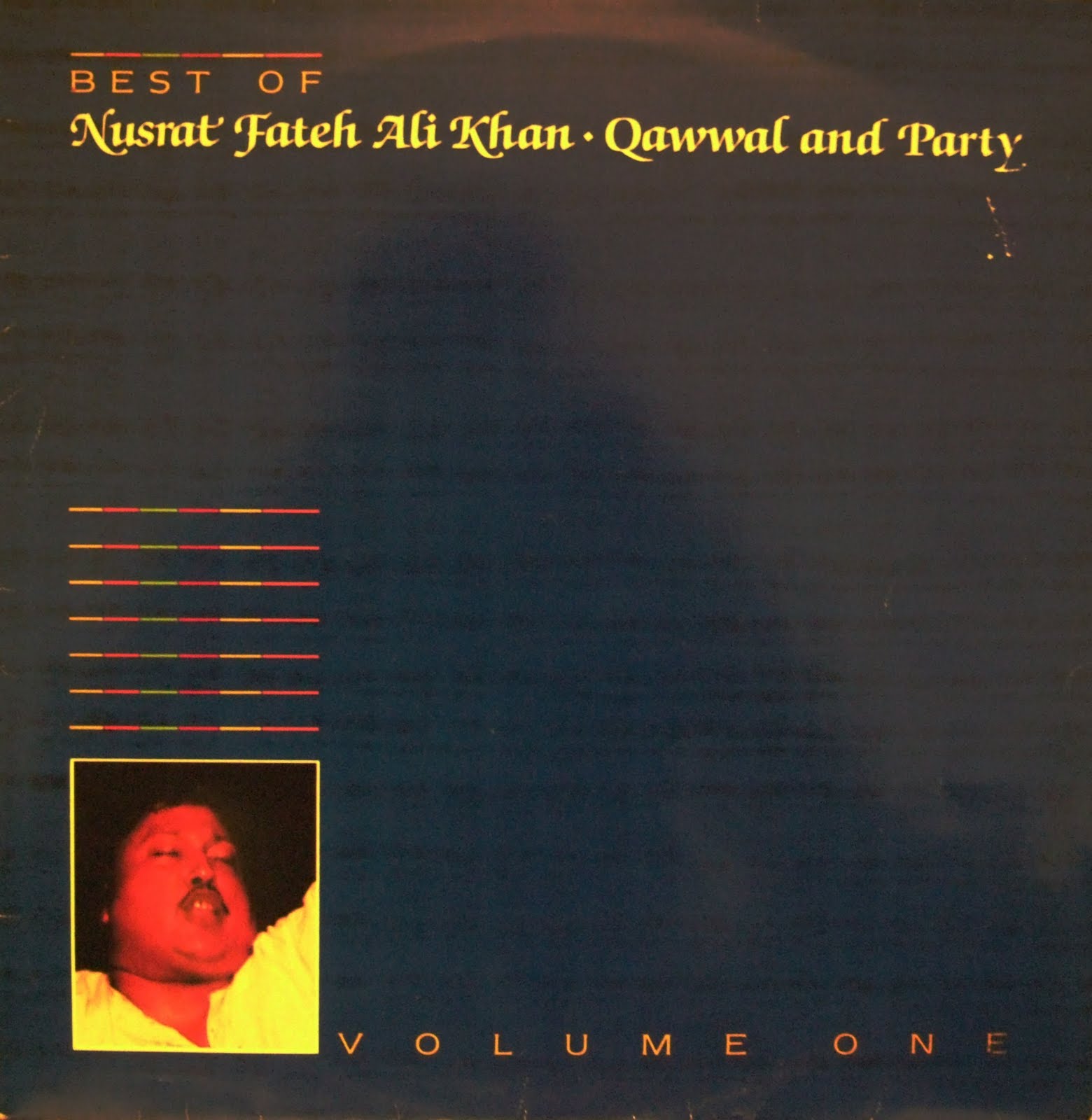
The Best of Nusrat Fateh Ali Khan Qawwal and Party Volume 1 (WOMAD/Oriental Star 1986)


About Qawwali:
Strong voices and explosive hand-clapping characterize
the devotional music known as qawwali. An
ensemble of usually 12 male performers conveys a
religious message through music and song based on
mystic poetry by Sufi masters. The texts usually deal
with divine love (’ishq), the sorrow of separation
(hijr, firaq) and the union (visal), these concepts being
symbolically reinforced and illustrated by the
music. Qawwali blends Iranian and Central Asian
poetic, philosophical and musical elements into a
North Indian base, combining popular music with
classical traditions. Following the same pattern of
combination and blending, the texts cover Arabic
and Persian, but the main text body is usually in a
simple idiom form of Indian languages: Urdu,
Hindi, Purbi and Punjabi. Qawwali is derived from
the Arabic word qaul, literally meaning “saying” but
has taken on the meaning of “belief ” or “credo” in
South Asian languages. Qawwali is spiritual in essence;
it is the devotional music of the Sufis to attain
trance and mystical experience—originating in the
10th century and blossoming into its present form
from the 13th century onwards.
Qawwali is inseparable from the name of a Persian
court musician, composer, poet and mystic of that
period: Amir Khusrau (1254-1325). Amir Khusrau
experimented with musical forms, combining the
Indian and the Persian, the Hindu Bhakti and the
Muslim Sufi to produce the present form of
qawwali.
Qawwali thus became a popular expression of
Muslim devotion open to all faiths throughout
Northern India. This form of music rapidly became
a vehicle for the Islamic missionary movement in
India, while at the same time reinforcing the faith of
the Muslims. In many cases, the original Persian
mystical text is followed by a translation in the local
idiom sung in the same manner as the original.
While the orthodoxy continues to reject what they
perceive as a blasphemous mixture of music and religion,
qawwali remains an expanding form of music
enjoying universal popularity in South Asia and
beyond. An even more energetic form of qawwali
developed around the 16th century in the middle
Indus at the crossroads between Iran, Central Asia
and India. This form, called the Punjabi ang, presents
the crystal-clear and profound texts of Punjabi
Sufi poetry and folk songs woven into attractive
melodies and powerful rhythms. The late Nusrat Fateh
Ali Khan belongs to this branch of qawwali.
http://hop.dartmouth.edu/assets/pdf/notes-qawwali.pdf


Tracklist:

01 Allah Hoo Allah Hoo
02 Yaad-e-Nabi Ka Gulshan Menka
03 Haq Ali Ali Haq
04 Ali Maula Ali Maula Ali Dam Dam
05 Mast Nazroon Se Allah Bachhae
06 Ni Main Jogi De Naal

Get it HERE.

Sunday, 5 July 2009

Ghulam Ali


Here's what wikipedia has to say about the ghazal:
The ghazal (Arabic/Persian/Urdu: غزل; Hindi: ग़ज़ल; Punjabi: ਗ਼ਜ਼ਲ, غزل; Turkish: gazel) is a poetic form consisting of rhyming couplets and a refrain. Each line must share the same meter. A ghazal may be understood as a poetic expression of both the pain of loss or separation and the beauty of love in spite of that pain. The form is ancient, originating in 6th century pre-Islamic Arabic verse. It is derived from the Arabian panegyric qasida. The structural requirements of the ghazal are similar in stringency to those of the Petrarcan sonnet. In its style and content it is a genre which has proved capable of an extraordinary variety of expression around its central themes of love and separation. It is one of the principal poetic forms the Indo-Perso-Arabic civilization offered to the eastern Islamic world.
The ghazal spread into South Asia in the 12th century under the influence of the new Islamic Sultanate courts and Sufi mystics. Although the ghazal is most prominently a form of Persian poetry and Urdu poetry, today, it is found in the poetry of many languages.
Ghazals were written by the Persian mystics and poets Jalal al-Din Muhammad Rumi (13th century) and Hafez (14th century), the Azeri poet Fuzuli (16th century), as well as Mirza Ghalib (1797–1869) and Muhammad Iqbal (1877–1938), who both wrote ghazals in Persian and Urdu.
...it is not possible to get a full understanding of ghazal poetry without at least being familiar with some concepts of Sufism. All the major historical post-Islamic ghazal poets were either avowed Sufis themselves (like Rumi or Hafiz), or were sympathizers with Sufi ideas. Most ghazals can be viewed in a spiritual context, with the Beloved being a metaphor for God, or the poet's spiritual master. It is the intense Divine Love of sufism that serves as a model for all the forms of love found in ghazal poetry.
Most ghazal scholars today recognize that some ghazal couplets are exclusively about Divine Love (ishq-e-haqiqi), others are about "earthly love" (ishq-e-majazi), but many of them can be interpreted in either context.
Traditionally invoking melancholy, love, longing, and metaphysical questions, ghazals are often sung by Iranian, Afghan, Pakistani, and Indian musicians. The form has roots in seventh-century Arabia, and gained prominence in the thirteenth- and fourteenth-century thanks to such Persian poets as Rumi and Hafiz. In the eighteenth-century, the ghazal was used by poets writing in Urdu, a mix of the medieval languages of Northern India, including Persian. Among these poets, Ghalib is the recognized master.
Ghulam Ali is a ghazal singer from Pakistan, famous across the Indian sub-continent and comfortable singing in Urdu, Punjabi and Nepali. The music on this album is completely mesmerizing, and Ali's voice soars across these songs, beautiful and melancholy.

Check this:


Track list:

01 Dil Mein ik Leher
02 Koi Sumihai Ye Kiya
03 Ghaam Nahin
04 Raseeley Toray Nain
05 Maine Lakhoon
06 Dost Bankar

Get it HERE.

Saturday, 13 December 2008

Bismillah Khan & Party - Music of India #9 (1969)


Ustad Bismillah Khan was a devout Shi'ite Muslim but also a devotee of the Hindu Goddess of art and wisdom. He often played at Hindu temples and festivals, his music a healing force to ease tensions between religious groups:

Tracklist:
01 Sarang
02 Dadra
03 Chandra Kauns
04 Kajaree

You'll find the zip here.