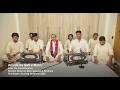
Jil Jilala were (alongside Nass el Ghiwane and Lemchaheb) one of the trinity of groups that emerged in the late '60s and early '70s with the intention of rejuvenating Moroccan folk musics. Formed in 1972 by members of a Sufi theatre group, the band based many of their songs on the religious and spiritual poetry of the Sufi brotherhoods.
In this video you can see the famous Gnawi, Mustafa Bakbou playing guimbri with the group:
Tracklist:
Side 1: Leklam Lemrassa3 (Adorned Talk) - Lighara (The Raid)- Lejwad (The Good People)
Side 2: Al Quds (Jerusalem) - Liyam Tnadi (The Days Are Calling)- Dada Oumie (My Elderly Mother)
Thanks as always to Tim for the translations and to Hammer for the translation to Enlglish. Much appreciated fellas!
"In the field of Amazigh (Berber) music, the experience of the group Izenzarn presents certain characteristics. The emergence of this group occurred in the general context of the social changes in the post-colonial Morocco. The emigration (rural migration in the Moroccan sociological terminology) became an irreversible phenomenon. The rural society settles in the town and is confronted at the same time with the violent process of integration and assimilation and with the social problems resulting from the arbitrary management of country by the makhzenian Mafia. This situation requires the invention of new forms of poetico-musical expressions (or the adaptation of the old forms) to express at the same time the nostalgia of the origins and the anger towards the abusive policies. Also, at this times, Anglo-Saxon musical groups (such as the Beatles) as well as Moroccan groups (Nass el Ghiwan, Jil Jilala, etc.) impose their rhythms and influence the development of musical groups known as popular. Mixing modern and traditional instruments, these groups interpret songs, inspired by the ancestral tradition or expressing the current sensibilities of a generation coming from the first wave of the rural emigrants.
Founded at the end of the Sixties by a group of young people from newly urbanized families, Izenzarn is among the first Amazigh groups to modernize and radicalize the Amazigh song. After tribulations under different names, a first album is recorded in the year 1974. Thus starts the first season of the group, characterized by love songs such as: Wad ittemuddun (traveler), Wa zzin (Oh! beauty), etc, or nostalgic and traditional songs: Immi Henna (My gracious mother)... In the beginning of the Eighties, Izenzarn embraces more protesting themes: ttuzzalt (dagger), ttâbla (plate), tamurghi (grasshoppers)...
The protest in Izenzarn's songs is characterized by the challenge of the dominant speeches:
Iggut lebrîh idrus may sellan igh islêh
Plenty of speeches And yet Nobody listens to the reason
and the harsh description of the reality:
Nettghwi zun d teghwi tmmurghi gh igenwan ikk d lhif akal
We are like grasshoppers taken between the skies and the dry grounds.
This reality is a world of fear, oppression and torture [tawda gh will ugharas (fear in the paths), izîtti wuzzal (iron bars), ur nemmut ur nsul (neither alive nor dead)]
The success of the group is due to its strange musical style and the poetry of its songs that presented already at the end of the Seventies the germs of a revolution in the modern Berber poetic creation.
After a disagreement, the group had split. Two groups dispute the name: Izenzarn Iggut Abdelhadi and Izenzarn Shamkh. But, it is the first one that imposed itself due to the emblematic image of its main singer, Iggut Abdelhadi."
Here's another 90 minutes of Izenzaren's amazing Amazigh music.
Lemchaheb, or The Torches, were along with Nass El Ghiwane and Jil Jilala, one of the founding groups of Moroccan Chaabi, a popular musical form that sought to blend traditional Moroccan folk music styles with Western pop styles to create an idiosyncratic sound. By the late seventies, Lemchaheb's music was charecterised by their use of the electric guitar, but that's nowhere to be heard on this beautiful early recording which instead features the gorgeous vocals of Saida Birouk, the female band member who was part of the group until 1978.
Lemchaheb's sound on these recordings is very melodic and quite gentle, in contrast to some of the other Moroccan music I've posted in the past, which might make it a good point of entry for the wary. The group are still well loved in Morocco and you may hear some of their songs being played by the groups of musicians that congregate in the Djemaa el Fna.
Here's a track from their 1978 album:
Tracklist:
Side 1: Lkhyala Amana Alwad Attalab
Side 2: Wana A Ommi Lalla Lakbira Kif Nghanni Ya Sah
Here's another of the cassettes I picked up on my most recent Marrakech excursion. This one is quite unusual in that the guitar, violin and flute take centre stage on these recordings and help Mbarek develop a very gentle, pastoral backing for his songs. This album was recorded and released in the year that Mbarek split from the group Ousman, another of the groups (alongside Nass El Ghiwane, Lemchaheb, Jil Jilala and Izenzaren) credited with spearheading a resurgence in the use of the Berber dialects in Moroccan popular culture.
Laayoun Ainya is one of the most famous Moroccan songs of the 1970s and something of an unofficial national anthem for many Moroccan nationals. This is a song you will hear played by the groups that gather in the Djemaa el Fna on balmy nights when crowds gather to be entertained and sing along to popular and familiar tunes. The song itself deals with important aspects of Moroccan nationalism and questions over the Moroccan claim to sovereignty over the Western Sahara and deals explicitly with the Green March, during which hundreds of thousands of unarmed Moroccans occupied desert lands.
On October 16th 1975, the International Court of Justice in the Hague issued an advisory opinion on the legal status of the area known as the western Sahara prior to the Spanish colonisation of the region in 1884. That night, King Hassan II appeared on Moroccan television and radio asking for 350000 volunteers to occupy the territory in an attempt to secure Moroccan sovereignty over the land. This sovereignty was contested by Mauritania, Algeria and many of the inhabitants of the sparsely populated desert region as represented by the Polisario movement. As a result of the occupation an agreement was signed which divided the land between Morocco and Mauritania, this resulted in fifteen years of Polisario's guerilla warfare against the Moroccan government.
I don't wish to get into the politics of the Green March, but the music contained in the grooves of this record is absolutely wonderful:
I suppose my views on nationalism and the idea of the nation state are best summed up by Benedict Anderson:
"In an anthropological spirit, then, I propose the following
definition of the nation: it is an imagined political community - - and
imagined as both inherently limited and sovereign.
"It is imagined because the members of even the smallest
nation will never know most of their fellow-members, meet them, or even
hear of them, yet in the minds of each lives the image of their
communion...all communities larger than primordial villages of face-to-face
contact (and perhaps even these) are imagined. Communities are to be
distinguished, not by their falsity/genuineness, but by the style in
which they are imagined. Javanese villagers have always known that they
are connected to people they have never seen, but these ties were once
imagined particularistically-as indefinitely stretchable nets of kinship
and clientship. Until quite recently, the Javanese language had no word
meaning the abstraction 'society.'...The nation is imagined as limited because even the largest
of them encompassing perhaps a billion living human beings, has finite,
if elastic boundaries, beyond which lie other nations. No nation
imagines itself coterminous with mankind. The most messianic
nationalists do not dream of a day when all the members of the human
race will join their nation in the way that it was possible, in certain
epochs, for, say, Christians to dream of a wholly Christian planet.
"It is imagined as sovereign because the concept was born
in an age in which Enlightenment and Revolution were destorying the
legitamcy of the divinely-ordained, hierarchical dynastic realm. Coming
to maturity at a stage of human history when even the most devout
adherents of any universal religion were inescapably confronted with the
living pluralism of such religions, and the allomorphism between each
faith's ontological claims and territorial stretch, nations dream of
being free, and, if under God, directly so. The gage and emblem of this
freedom is the sovereign state.
"Finally, it is imagined as a community, because,
regardless of the actual inequality and exploitation that may prevail in
each, the nation is always conceived as a deep, horizontal comradeship.
Ultimately it is this fraternity that makes it possible, over the past
two centuries, for so many millions of people, not so much to kill, as
willingly to die for such limited imaginings.
"These deaths bring us abruptly face to face with the central
problem posed by nationalism: what makes the shrunken imaginings of
recent history (scarcely more than two centuries) generate such colossal
sacrifices? I believe that the beginnings of an answer lie in the
cultural roots of nationalism."
The music is, of course, for evaluation purposes only. If you like what you hear then go out and try and buy stuff...or something, give money to a down on his luck musician, or sponsor a good busker, it may be the start of something beautiful.
If any of the zips die, then post a comment and i'll try to repost. And leave comments, abuse, name calling, any response is welcome.
I think all of the albums posted are currently unavailable, but if this is not the case we'll remove the offending files.

 Jil Jilala were (alongside Nass el Ghiwane and Lemchaheb) one of the trinity of groups that emerged in the late '60s and early '70s with the intention of rejuvenating Moroccan folk musics. Formed in 1972 by members of a Sufi theatre group, the band based many of their songs on the religious and spiritual poetry of the Sufi brotherhoods.