Saturday, 21 July 2012

Lanrewaju Adepoju & His Akewi Theatre - Volume 3


Here's a treat.  Lanrewaju Adepoju was (is?) a famous Yoruban poet an on this 1975 recording they deliver an exciting blend of highlife, juju and afrobeat sounds that you just might like.  And if you do, you can find another wonderful LP over here.

Tracklist:

Side One - Igba oro ki i fo/Maa see e niso/Oyinbo Kare
Side Two - Timi agbale waja/Baba dari ji wa/Oga l'olowo

Get it HERE.

Thursday, 12 July 2012

Jil Jilala - Laayoun Ainya


Laayoun Ainya is one of the most famous Moroccan songs of the 1970s and something of an unofficial national anthem for many Moroccan nationals.  This is a song you will hear played by the groups that gather in the Djemaa el Fna on balmy nights when crowds gather to be entertained and sing along to popular and familiar tunes.  The song itself deals with important aspects of Moroccan nationalism and questions over the Moroccan claim to sovereignty over the Western Sahara and deals explicitly with the Green March, during which hundreds of thousands of unarmed Moroccans occupied desert lands.

On October 16th 1975, the International Court of Justice in the Hague issued an advisory opinion on the legal status of the area known as the western Sahara prior to the Spanish colonisation of the region in 1884.  That night, King Hassan II appeared on Moroccan television and radio asking for 350000 volunteers to occupy the territory in an attempt to secure Moroccan sovereignty over the land. This sovereignty was contested by Mauritania, Algeria and many of the inhabitants of the sparsely populated desert region as represented by the Polisario movement. As a result of the occupation an agreement was signed which divided the land between Morocco and Mauritania, this resulted in fifteen years of Polisario's guerilla warfare against the Moroccan government. 

I don't wish to get into the politics of the Green March, but the music contained in the grooves of this record is absolutely wonderful:

I suppose my views on nationalism and the idea of the nation state are best summed up by Benedict Anderson: 
"In an anthropological spirit, then, I propose the following definition of the nation: it is an imagined political community - - and imagined as both inherently limited and sovereign.
"It is imagined because the members of even the smallest nation will never know most of their fellow-members, meet them, or even hear of them, yet in the minds of each lives the image of their communion...all communities larger than primordial villages of face-to-face contact (and perhaps even these) are imagined. Communities are to be distinguished, not by their falsity/genuineness, but by the style in which they are imagined. Javanese villagers have always known that they are connected to people they have never seen, but these ties were once imagined particularistically-as indefinitely stretchable nets of kinship and clientship. Until quite recently, the Javanese language had no word meaning the abstraction 'society.'...The nation is imagined as limited because even the largest of them encompassing perhaps a billion living human beings, has finite, if elastic boundaries, beyond which lie other nations. No nation imagines itself coterminous with mankind. The most messianic nationalists do not dream of a day when all the members of the human race will join their nation in the way that it was possible, in certain epochs, for, say, Christians to dream of a wholly Christian planet.
"It is imagined as sovereign because the concept was born in an age in which Enlightenment and Revolution were destorying the legitamcy of the divinely-ordained, hierarchical dynastic realm. Coming to maturity at a stage of human history when even the most devout adherents of any universal religion were inescapably confronted with the living pluralism of such religions, and the allomorphism between each faith's ontological claims and territorial stretch, nations dream of being free, and, if under God, directly so. The gage and emblem of this freedom is the sovereign state.
"Finally, it is imagined as a community, because, regardless of the actual inequality and exploitation that may prevail in each, the nation is always conceived as a deep, horizontal comradeship. Ultimately it is this fraternity that makes it possible, over the past two centuries, for so many millions of people, not so much to kill, as willingly to die for such limited imaginings.
"These deaths bring us abruptly face to face with the central problem posed by nationalism: what makes the shrunken imaginings of recent history (scarcely more than two centuries) generate such colossal sacrifices? I believe that the beginnings of an answer lie in the cultural roots of nationalism."
Anderson, Benedict. Imagined Communities: Reflections on the Origin and Spread of Nationalism. Revised Edition ed. London and New York: Verso, 1991, pp. 5-7.

Tracklist:

01 Laayoun Ainya
02 Jlatni Riahak
03 Darat Addawra
04 Ennas Fi Lahoua Nachdate

Get it HERE.

Sunday, 8 July 2012

Alla Pugacheva - Mirror of the Soul (1978)


This 1978 compilation of songs by Alla Pugacheva is a quite incredible collection of Communist era prog rock, soul, psychedelia and big, ballsy balladeering from one of Russia's most popular and enduring stars.  For all the funky goodness on display here, Alla was, for many, the epitome of the State-endorsed Culture Industry of the late Soviet era - safe, manufactured entertainment designed to pacify the mind.  Sound familiar?  For all that, I'm loving some of these mad tracks at the minute - the producers obviously had lots of fun, and it sometimes seeps into a lovely kind of Pink Floyd-esque territory.  Anyone who enjoyed the Patty Pravo album I posted a while back will want to check this out.

Here is a severely abridged version of 'Shaman's Tambourine':

Tracklist:

01         Бубен Шамана · Witch-Doctor's Tambourine        
02         Верю В Тебя · I Believe In You   
03         Сонет · Sonnet         
04         Приезжай · Come        
05         Не Отрекаются Любя · Those Who Love Don't Renounce         
06         Песенка Про Меня · A Song About Me         
07         Женщина Которая Поет · The Woman Who Sings

Get it HERE.

Saturday, 30 June 2012

Tapper Zukie - Peace in the Ghetto


Tapper Zukie was one of the most popular roots artists of the mid to late '70s, both here in the UK and in Jamaica.  In 1976 he was the warm up act on Patti Smith's UK tour.

This 1978 album sees the man in fine form toasting over some familiar tracks (I'm sure many listeners will recognise the fabulous 'Ghetto Rock').


Tracklist:

01    Peace In The Arena         
02    The City Of Mount Zion         
03    Ghetto Rock
04    Tribute To Steve Biko    
05    Dangerous Woman         
06    Get On The Double         
07    Praise Jah In Gladness         
08    Peace In The City         
09    Bimbo Bimbo

Get it HERE.

Friday, 22 June 2012

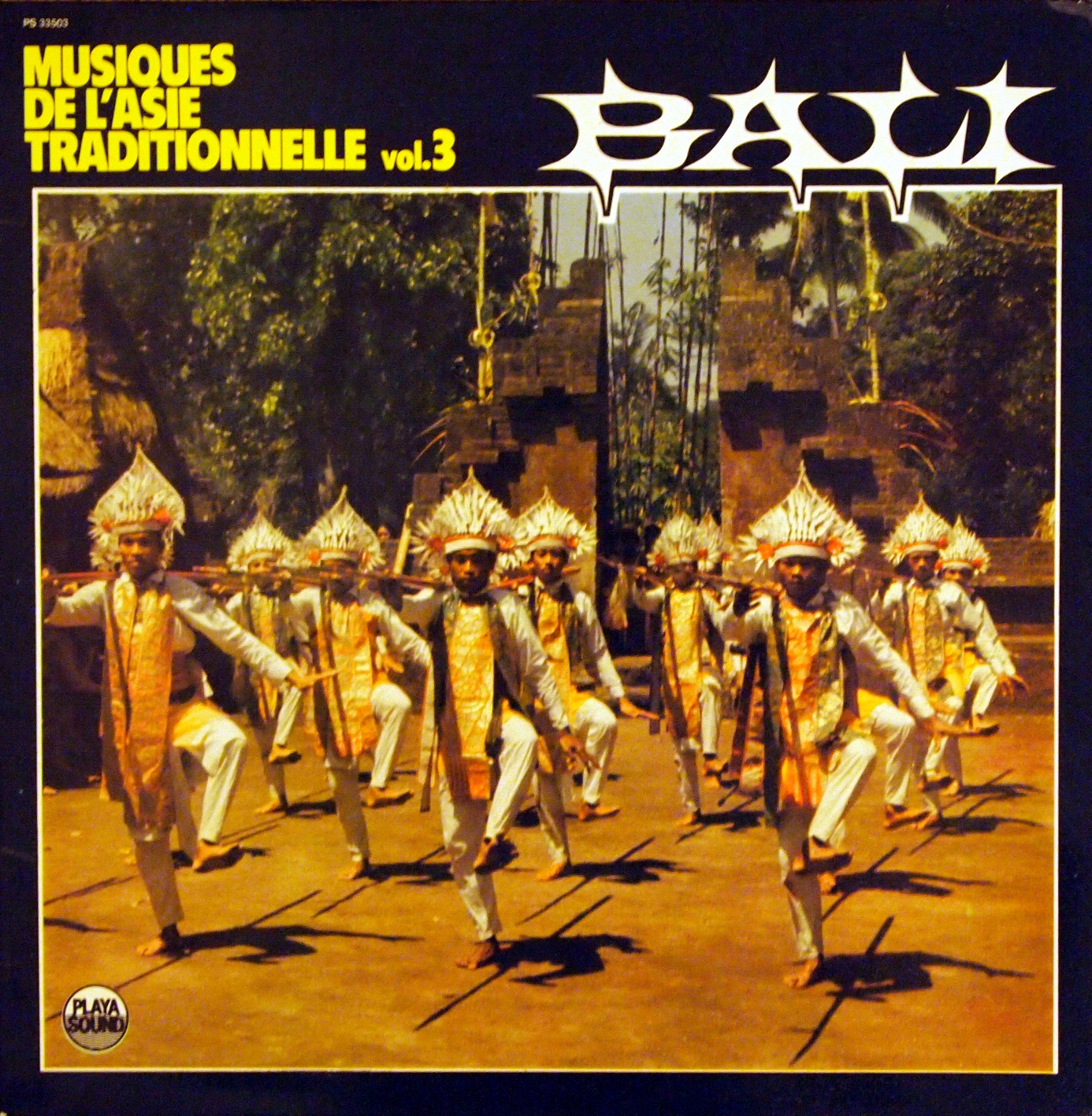
Musiques De L'Asie Traditionelle Vol.3 - Bali


This incredible record contains, without any doubt, my favourite recordings of Balinese gamelan music.  Beautifully measured, stately music that just seems to stand outside of time.

Tracklist:

01         Baris Jago    
02         Rejang Renteng    
03         Légong Kraton

Get it HERE.     

Sunday, 17 June 2012

The Gun Club - Danse Kalinda Boom (Live in Pandora's Box)


I first bought this album in '85 or '86 having read something in NME about Jeffrey Lee Pierce and his self-destructive ways.  I made the purchase at the local record shop in Bishop Auckland, Brothertons Music, at the time an old fashioned place that also sold sheet music.  David, the shop assistant always wore a suit and the other assistant, Ruby, was good friends with my grandmother.  Strange that this dusty place should have held so many weird and wonderful records and played such a crucial part in my musical education.  I would regularly spend my paper round money in there and around the same time I bought Captain Beefheart's Safe as Milk on cassette and Fresh by Sly and the Family Stone.

In the mid '90s when I moved South, many of my records were sold and this was one of those that went, but its also long been one of the records that I regretted selling so I was very pleased to find it again recently, and you'll be pleased too as I'm now able to share it here.

The Gun Club were a seminal '80s blues-punk band who, despite a number of line-up changes, managed to channel the spirits of all the dead outlaw rock 'n' rollers through their primal rockabilly howl.  This is a stunning live recording of a band at the height of their powers.  This line-up sees The Cramps' Kid Congo Powers taking most of the lead guitar and Patricia Morrison (later of the Sisters of Mercy) on bass duty.  The performances are electric from start to finish.

Here's some live footage from 1984:


Tracklist:

01 Eternally Is Here        
02 Bad America        
03 Stranger In Town        
04 Gila Monster, New Mexico / Preaching Blues        
05 Sleeping In Blood City        
06 Goodbye Johnny        
07 Give Up The Sun

Get it HERE.

Tuesday, 12 June 2012

Freres Bouchenak (1984)

The brothers Bouchenak were a proto-Rai group from Morocco formed in the late '70s and disbanded in the late '80s.  This album was released in 1984 and it contains some rocking cuts, complete with gnawa qraqabs and bubbly synths.
As usual, any more info on this group or these songs would be much appreciated.

Tracklist:

01 Mimouna
02 N'Oublier Pas
03 Barbare
04 Orphelin
05 Trouble

Get it HERE.